
← All posts

26 Jul 2026

De-Risking Early-Stage Game Investments: Moving Beyond Intuition

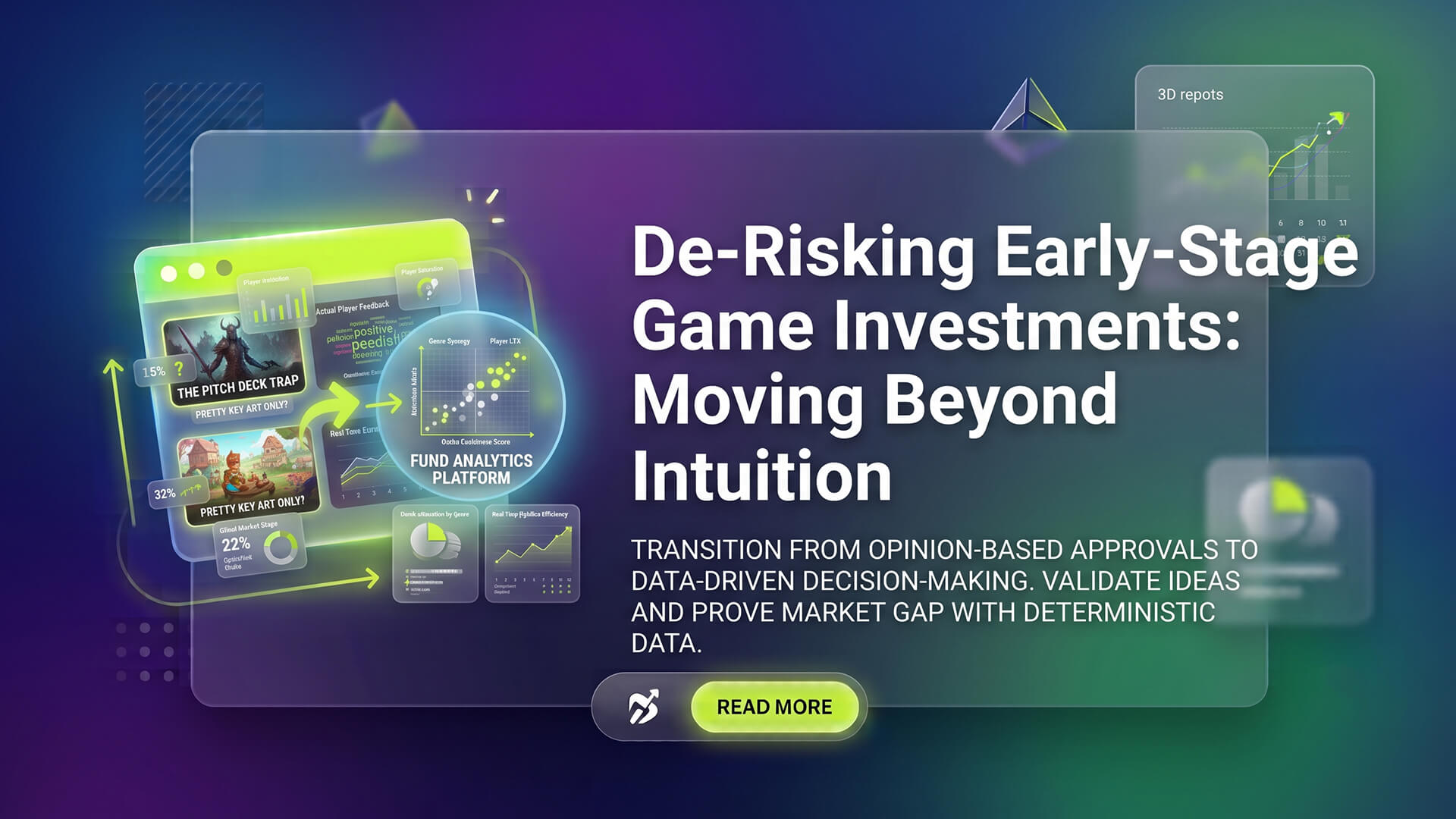
De-Risking Early-Stage Game Investments: Moving Beyond Intuition
For decades, early-stage game investing looked more like art patronage than venture capital. Investors evaluated founders over coffee, played rough prototypes, and relied heavily on "gut feeling" to decide which game concepts deserved millions of dollars in seed funding. If a pitch sounded exciting and the team had a respectable resume, the investment got greenlit.

In today's gaming ecosystem, relying on intuition to allocate early-stage capital is a recipe for portfolio write-offs.

With over ten thousand games launching on Steam every year, the margin for error has vanished. Production costs for indie and AA games continue to rise, while player attention remains fiercely defended by established live-service giants. To achieve consistent returns, venture funds, strategic angels, and game publishers must de-risk early-stage game investments by shifting from subjective intuition to quantitative risk management.


The Flaws of Intuition-Led Capital Allocation

Intuition is not inherently bad; it is simply unscalable and prone to severe cognitive biases. When investors rely solely on experience and instinct during pre-seed and seed rounds, several structural failure points emerge:

  • The Halo Effect: Investors overvalue pitches from ex-AAA developers, assuming that corporate experience at a massive studio automatically translates to commercial hit-making as an independent founder.
  • Recency Bias: A sudden, viral hit in a niche subgenre leads investors to fund dozens of copycat concepts, ignoring the fact that by the time these new projects finish production, the trend will have completely burned out.
  • Narrative Seduction: A compelling story about world-building, lore, and artistic vision can easily overshadow hostile market dynamics, leading investors to fund passion projects that lack an actual target audience.

When an investment thesis is built on intuition, the fund takes on maximum execution risk and maximum market risk simultaneously.


The Pillars of Data-Backed De-Risking

De-risk early-stage game investments does not mean eliminating creative risk—great games require bold artistic choices. It means identifying and eliminating preventable market risks before writing a check.

Smart investors de-risk their portfolio during the pre-production phase across three specific vectors:

  1. Supply-Demand Ratio Audits
    • Before evaluating a studio's pitch deck, examine the exact subgenre market dynamics on Steam. Is the target category expanding in active player hours, or is player attention contracting into a few legacy titles?
    • If a pitch proposes a traditional survival-crafting game, but data shows that ninety percent of new releases in that tag cluster fail to break fifty reviews, the concept carries extreme structural supply risk.
  2. Identifying the "Market Gap"
    • A de-risked game concept occupies a clear gap in the competitive landscape. This gap can take several forms:
      1. Mechanical Hybridization: Merging two proven, non-competing gameplay loops to create a fresh subgenre hook.
      2. Pricing and Scope Arbitrage: Delivering a high-value experience in a category where existing options are either overpriced or abandoned by their original developers.
      3. Visual Contrast: Offering a distinct, eye-catching aesthetic that immediately separates the title from competitors in Steam capsule previews.
  3. Evaluating Pivot Vector Potential
    • The best early-stage investments are made in teams and concepts that possess clear pivot vectors. If market conditions shift or early playtest metrics show friction, can the core codebase and visual assets be adapted to an adjacent, less saturated subgenre without burning the entire runway?


Building a Systemic Risk Framework

To move beyond intuition, investment teams must implement standardized evaluation benchmarks across their deal pipeline:

  1. Mandatory Market Audits: Require every incoming deal to pass an objective market density test before advancing to partner meetings.
  2. Standardized Scoring: Replace qualitative pass/fail notes with repeatable numerical scores evaluating market gap, visual positioning, and subgenre saturation.
  3. Continuous Tracking: Track concept positioning parameters throughout the pre-production milestone cycle to ensure the studio maintains its market advantage as development progresses.


Protecting Capital While Fueling Innovation

De-risking is not about suppressing creativity or forcing developers to make boring, trend-chasing games. It is about ensuring that bold, creative ideas are deployed in market spaces where players are actually waiting to buy them.

By replacing subjective intuition with cold market arithmetic, investors protect their LP capital, reduce portfolio failure rates, and give visionary founders the data-backed foundation they need to succeed.


Stop Guessing. Validate Your Market Space.

De-risk your investment portfolio with objective market arithmetic before committing capital.

KillScore evaluates game concepts against 127,000+ Steam titles to calculate exact market saturation and density. Run your parameters through our decision engine and get a math-backed verdict before writing your first line of code.

Analyze Your Concept on KillScore →